iPhone Backup Taking Forever? 6 Ways to Speed It Up



Two hours in, the progress bar has moved a centimeter, and you’re wondering whether to pull the plug. Don’t yet. An iPhone backup taking forever splits into two very different stories, one where everything is working exactly as designed and one where a fixable problem is strangling the transfer. Here’s how to tell them apart, and the six fixes for the second kind.
Summary
A first full backup moves your whole iPhone across one cable and honestly takes hours. Later backups copy only changes and finish fast. When any backup crawls or stalls, the fixes run through the cable and port, Windows sleep settings, security software, free disk space and a broken old backup blocking the new one.
| Symptom | Most Likely Story |
|---|---|
| First ever backup, slow but moving | Normal. A full phone takes hours over one cable |
| Stuck on estimating time remaining | Connection handshake problem, not a speed problem |
| Same percentage for an hour | Antivirus inspecting every file, or a dying cable |
| Fails near the end, every time | Disk space or security software at final verification |
Table of Contents
- Why Is Your iPhone Backup Taking Forever?
- Is It Slow or Actually Stuck?
- Fixes 1 to 3. Cable, Port and Sleep Settings
- Fix 4. Pause the Security Software
- Fixes 5 and 6. Disk Space and the Blocking Backup
- The Structural Fix. Shrink What the Backup Carries
- After It Finally Completes
- Frequently Asked Questions
Why Is Your iPhone Backup Taking Forever?
Start with the fact that reframes everything. Backups are incremental. The first one copies the entire phone, tens of gigabytes of photos, videos, messages and app data, through a single cable. Every backup after it copies only what changed since last time.
So a slow first backup is the system working. The phone with years of photos genuinely needs hours, and the right move is starting it before bed. A slow twentieth backup is different. Something is in the way, and the fixes below remove the usual suspects in order of likelihood.
Is It Slow or Actually Stuck?
Watch two signals for ten minutes. Does the progress bar advance at all, even slightly? And does the phone show the backup in progress? A bar that creeps is a transfer that’s working, however slowly. A bar frozen at the same pixel with the message stuck on estimating time remaining points at the connection rather than the speed, and that’s the territory of our guide on an iPhone not showing up in iTunes, where the driver and service fixes live.
Genuinely moving but painfully slow? Continue below.
Fixes 1 to 3. Cable, Port and Sleep Settings
Fix 1. Go direct. Plug the cable straight into the PC. Hubs, extension leads and front panel ports add failure points that show up as crawling transfers and mid backup disconnects.
Fix 2. Change the cable. A fraying cable degrades before it dies, and slow unstable transfers are the symptom of its decline. Swap in a known good data cable and compare.
Fix 3. Stop Windows from sleeping mid job. A PC that naps partway leaves a half written backup, which is how the corruption stories start. Open Settings, then System, then Power, and set sleep to Never while plugged in, at least for backup evenings.
Fix 4. Pause the Security Software
Here’s the biggest hidden brake. A backup writes thousands of hashed files in quick succession, and security software that inspects every single one turns a fast transfer into a crawl. Apple lists security software among the first suspects for backup trouble in its official troubleshooting guide.
Pause the antivirus for the duration of the backup, run it, and turn protection back on when the bar completes. One comparison run with it paused tells you whether it’s been the brake all along.
“The backup that takes forever is almost always doing exactly what it should. A first full backup moves an entire phone across one cable, and that costs an evening. The one worth worrying about shows the same percentage for an hour, and that one is nearly always the antivirus holding every file up for inspection.”
Viralkumar Patel in | iData Backup Viewer Team, CYBERSICS SOLUTIONS
Fixes 5 and 6. Disk Space and the Blocking Backup
Fix 5. Clear room on C:. The backup needs space for tens of gigabytes plus working room, and a nearly full drive slows everything before it kills the job outright. Keep at least 20GB free beyond the expected backup size, and reclaim space from old snapshots using our guide on deleting iPhone backups safely.
Fix 6. Move the broken old backup aside. A damaged previous backup makes the new run stumble over it, showing up as stalls or a corrupt error at the finish line. Move the device’s old folder out of the Backup directory and let the new backup start clean, the same maneuver from our guide on the corrupt or not compatible backup error.
The Structural Fix. Shrink What the Backup Carries
Photos and videos are the bulk of almost every backup, so the structural lever is moving the library to iCloud Photos. Do that and the computer backup shrinks dramatically and speeds up to match.
Know the tradeoff before pulling that lever. Once iCloud Photos holds your library, the computer backup stops including it, which changes what that backup can recover for you later, exactly the catch we covered in our guide on extracting photos from an iPhone backup. Faster backups, thinner safety net. Choose with open eyes rather than for speed alone.
After It Finally Completes
A finished progress bar earns one more minute of your attention. Confirm the backup is real by looking inside it. iData Backup Viewer previews the messages, photos and contacts the fresh backup captured, free, on Windows 10 and 11. After a backup that fought you the whole way, seeing your data sitting readable is the only proof worth having, and our guide on backing up an iPhone to a computer covers keeping the next run healthy.
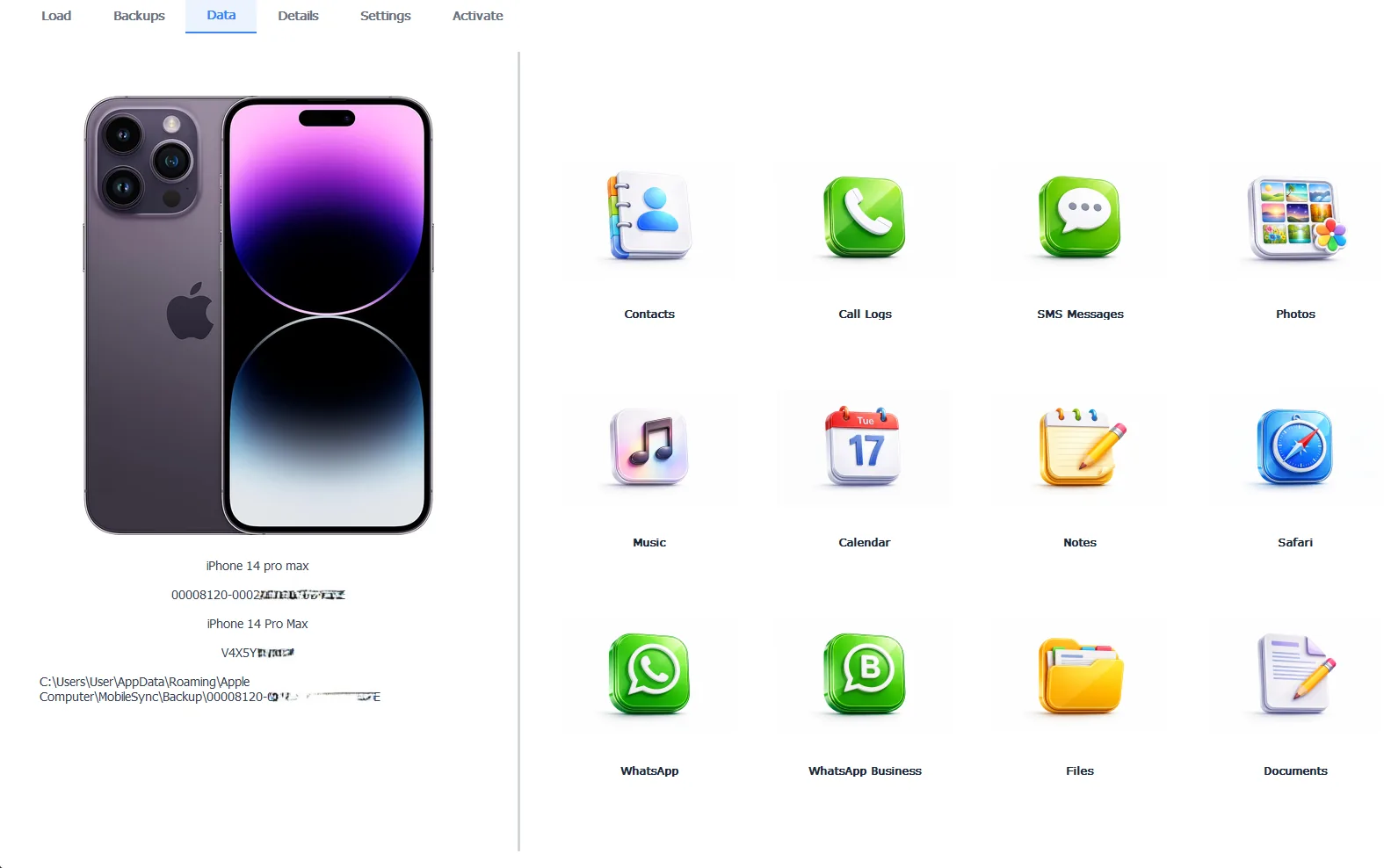
The finish line: backup contents verified by category on your PC
The preview stays free, and the Pro edition at $49 per year adds exports for the day you need data out. Everything runs 100% locally.
Free version previews your backup contents. Works on Windows 10 and 11.
So give the first backup its evening, and give every slow one after it the six checks. Direct port, fresh cable, no sleep, paused antivirus, room on the drive and a clean start away from the broken old backup. Somewhere in that list your transfer gets its speed back.
Is tonight’s backup a first full run that needs patience, or a stalled one that needs the list?
Frequently Asked Questions
How long should an iPhone backup take?
A first full backup moves your entire phone across one cable, and a heavily loaded iPhone stretches that into hours. Every later backup copies only what changed, finishing in minutes. Judge speed against which of the two you’re running.
Why does it stay stuck on estimating time remaining?
That message means iTunes and the phone are still negotiating the connection rather than moving data. A stalled Apple Mobile Device Service or a flaky cable causes most of it, and the connection fixes in our iTunes troubleshooting guide clear it.
Does encryption make the backup slower?
The difference is small, and the payoff is large. Encryption is what carries your Health data and saved passwords into the backup, so leave it on and spend the extra moments.
Can I use the PC while it backs up?
Yes. Browsing and working alongside a backup is fine. What kills backups is the PC going to sleep or the cable coming loose, so keep it awake and plugged until the bar completes.
Why is my backup suddenly smaller and faster than before?
Something moved out of it, and iCloud Photos is the usual answer. Once your photo library syncs to iCloud, Apple excludes it from the computer backup, which shrinks the backup and changes what it can recover for you.
It failed at the very end. Now what?
An almost finished backup that dies has run into disk space or security software at the final verification. Free up room on C:, pause the antivirus and run it again. Repeated failures move you into corrupt backup territory, which has its own guide.
Written by Viralkumar Patel in
Viralkumar works on iData Backup Viewer at CYBERSICS SOLUTIONS, where he helps Windows users read, recover and export data from iPhone backups.