Are iPhone Messages Admissible in Court? (2026)



A custody case can turn on a single thread of texts. So the question matters. Are iphone messages admissible in court? And does the way you saved them hold up? The short answer is yes, iPhone messages can be used as evidence when they are relevant and properly authenticated. The longer answer is that how you preserve them decides how easily the other side can challenge them. This article explains the general landscape in plain terms. It is not legal advice. A lawyer is the right person for your specific case.
Not legal advice. This page gives general information about how text-message evidence works. Rules of evidence vary by court and case. Confirm anything that affects a real legal matter with a qualified attorney or the court clerk.
Quick Answer
iPhone messages are admissible in court when they are relevant to the case and properly authenticated, meaning you can show who sent them and that the content is unchanged. Screenshots are the weakest form, since they lack metadata and are easy to edit. A message export from the phone backup, with timestamps and sender details, is stronger evidence. This is general information, not legal advice.
| Form of Evidence | How Strong Is It? |
|---|---|
| Backup export with metadata | Strongest, timestamps and sender kept |
| Full conversation, not cherry-picked | Stronger, answers the fairness objection |
| Carrier records | Metadata only, no message content |
| Screenshots alone | Weakest, easy to challenge |
Table of Contents
Are iPhone Messages Admissible in Court?
Yes, in general. Courts in both civil and criminal cases accept text messages as digital evidence, which includes iMessage and SMS from an iPhone. Divorce, custody and harassment matters routinely turn on them. Two conditions carry most of the weight. The messages must be relevant to the case. They must also be authenticated, meaning the person presenting them can show they are genuine.
What varies is not whether texts can be used, but how well a given copy survives a challenge. A message saved one way sails through. The same message saved another way gets excluded. That difference is the real subject of this page. It is also why confirming the format with a lawyer matters before you rely on anything.
What Does Authentication Mean?
Authentication is the legal test that evidence is what it claims to be. Under the Federal Rules of Evidence, Rule 901(a), the party offering the messages must show enough proof to support a finding that they are genuine. In plain terms, you have to show who sent the message and that nobody changed it after the fact.
Courts authenticate texts in a few common ways. Metadata like timestamps and sender details, testimony from someone who saw or sent the messages, phone records that tie a number to a person, plus distinctive content that only the real sender would know. Authentication is a separate hurdle from hearsay, which is its own question a lawyer handles. The stronger your preserved metadata, the easier authentication becomes.
Why Are Screenshots Weak Evidence?
Screenshots are the most common way people save texts and the easiest to attack. The problem is two-fold. A screenshot strips away the metadata, the phone numbers, the message type and the hidden timestamps, so it shows words without the data that proves them genuine. And a screenshot is just an image, editable with basic tools, so the other side can argue it was fabricated.
Courts have excluded screenshots that lacked metadata. In some cases fabricated screenshots have caused real harm. A screenshot is a secondary copy that drops the underlying record. When the native data with intact metadata is available, a court can treat a screenshot as the weaker, inferior version. Screenshots are not useless, but they are the format most open to challenge.
What Makes Message Evidence Stronger?
Two things lift text evidence above a bare screenshot. The first is preserved metadata. Phone numbers, exact timestamps, message type and sender details help a court verify the messages instead of taking them on faith. The second is completeness. Showing the full conversation, not a few cherry-picked lines, answers the objection that context got removed to mislead.
A record exported from the phone’s backup carries that metadata, which is why a backup-based export is widely considered stronger than a screenshot. Our companion guide to printing text messages from iPhone for court walks the practical steps of producing that kind of record, with sender names and timestamps on every message. Carrier records are a separate source, holding metadata about which numbers texted when, but not the message content itself, so they answer part of the authentication question rather than all of it.
How Do You Preserve Messages Properly?
Preserving messages well means keeping the metadata and the whole thread, in a format you can hand to a lawyer. The practical route runs through a computer backup of the iPhone, then an export that keeps the details intact.
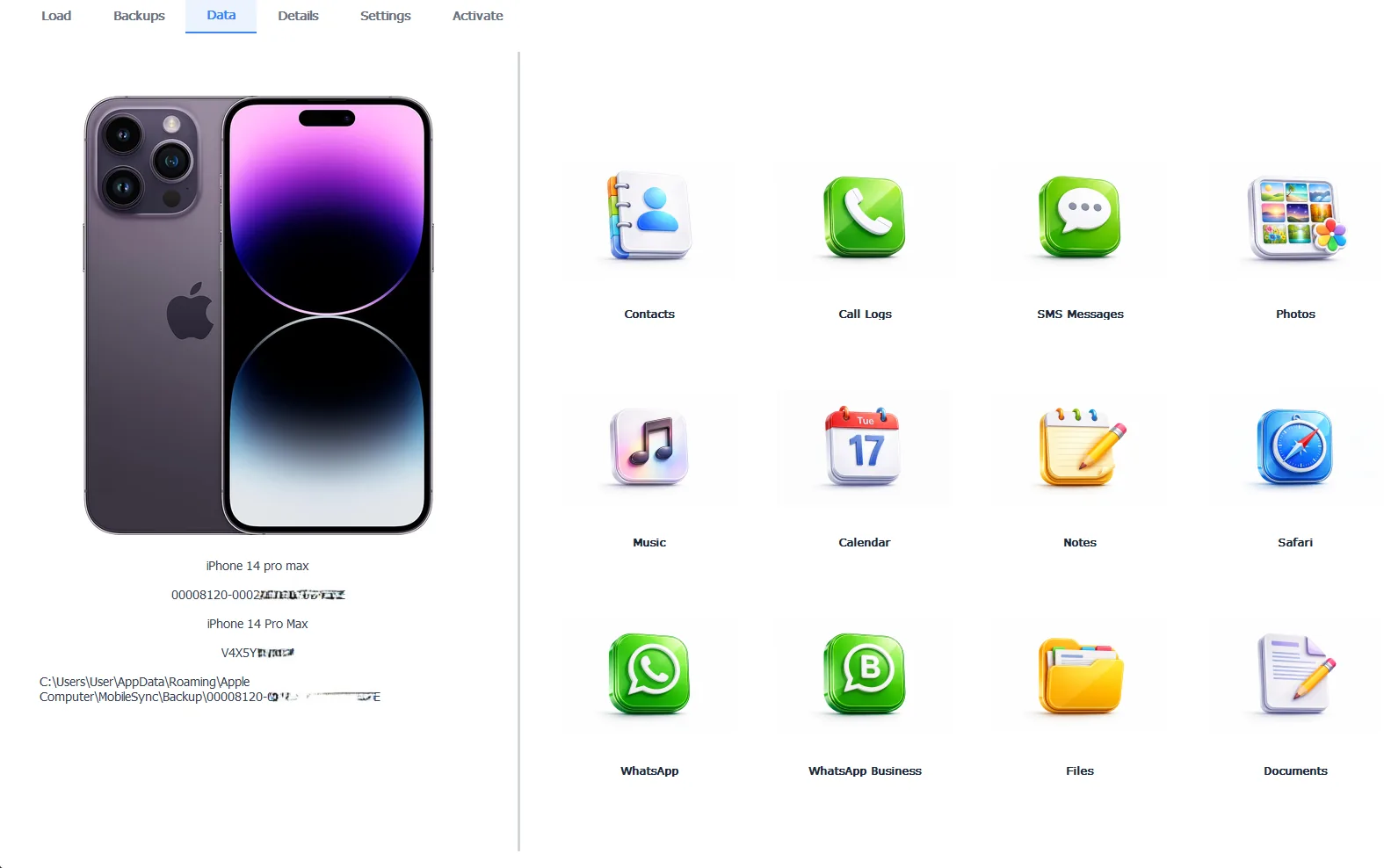
iData Backup Viewer opens an iPhone backup on Windows 10 or 11 and shows every conversation with its dates and sender details, free to browse. It exports whole conversations with timestamps to PDF or CSV, the metadata-preserving record that holds up better than a screenshot, with the export craft covered in our guide to saving text messages to your computer. Deleted messages that still sit in an older backup can be recovered and preserved the same way, following our guides to recovering deleted text messages and recovering deleted text message attachments.
A full conversation exported with timestamps, the record courts prefer
Browsing the backup is free, which lets you confirm the conversation is complete before exporting. Exporting takes the Pro edition at $49 per year, running 100% locally so the messages never leave your PC. Keep the original backup too, since the unaltered source can matter if an export is ever questioned.
Free version previews your backup contents. Works on Windows 10 and 11.
“We are not lawyers and we say so clearly. What we know is the data. A screenshot throws away the timestamps and sender records that prove a message is real, while a backup keeps them. People hurt their own case by saving the weakest possible version. Keep the metadata, keep the whole thread, keep the original backup, then let a lawyer do the legal part.”
Viralkumar Patel in | iData Backup Viewer Team, CYBERSICS SOLUTIONS
Whether iPhone messages help in court comes down to a few plain points:
- iPhone messages are admissible in most cases when they are relevant and authenticated.
- Authentication means showing who sent the messages and that nobody changed them.
- Screenshots are the weakest form, since they drop the metadata that proves authenticity.
- A backup export with timestamps and the full thread is the stronger record to preserve.
This page is general information, not legal advice, so the most important step is to confirm your plan with a qualified attorney. Have you preserved the full thread with its metadata or only a screenshot?
Frequently Asked Questions
Are iPhone text messages admissible in court?
Yes, iPhone text messages are admissible in most courts when they are relevant to the case and can be authenticated. Authentication means showing who sent the message and that its content has not been altered. Courts in civil and criminal cases accept properly authenticated texts. Confirm the exact requirements with your attorney or the court.
Are screenshots of text messages enough for court?
Screenshots can be admitted but are the weakest form of text evidence. They lack metadata like phone numbers and message type. Image tools also make them easy to edit, so the other side can challenge them. A backup export that preserves metadata is harder to dispute. A lawyer can advise on what a specific court will accept.
What makes text message evidence stronger?
Preserved metadata and the full conversation. Phone numbers, timestamps, message type and sender details help prove the messages are genuine. Showing the entire thread rather than a few cherry-picked texts answers the fairness objection. An export from the phone’s backup keeps this metadata, unlike a plain screenshot.
Can deleted messages be used as evidence?
Sometimes, when they can be recovered and authenticated. A message deleted from the phone can still sit in an older backup saved before the deletion. A recovered message is treated like any other, needing the same authentication. Whether a given deleted message is recoverable depends on the backups that exist. A lawyer guides what is usable.
Does metadata matter for iPhone message evidence?
Metadata is central. Timestamps, sender and recipient information, plus message type (SMS, iMessage or MMS) are what courts use to authenticate texts. Screenshots strip this away, which is their core weakness. A backup export carries the metadata that a screenshot cannot.
Should I talk to a lawyer about using iPhone messages in court?
Yes. Rules of evidence vary by court and case, so a qualified attorney is the right source for whether and how your messages can be used. This article explains the general landscape and how to preserve messages well, but it is not legal advice and does not replace a lawyer.
Written by Viralkumar Patel in
Viralkumar works on iData Backup Viewer at CYBERSICS SOLUTIONS, where he helps Windows users read, recover and export data from iPhone backups.
Last updated September 2026. General information only, not legal advice.