iTunes Backup vs iCloud Backup (Which Should You Use?)



Apple gives you two ways to back up an iPhone, and the internet argues about them like sports teams. The truth is less dramatic and more useful. The iTunes backup vs iCloud backup question has a clear answer once you see what each one actually does, what each one costs and the single difference that never makes the comparison charts.
Summary
In the iTunes backup vs iCloud backup comparison, iCloud wins on automation and off site safety while the computer backup wins on cost, speed and control. The difference that settles it for many people is readability. A computer backup opens in a viewer on your PC, while an iCloud backup can only ever be restored.
| Computer Backup (iTunes) | iCloud Backup | |
|---|---|---|
| Cost | Free at any size, uses your drive | Free 5GB, paid plans beyond that |
| Runs automatically | No, you connect and run it | Yes, overnight on power and Wi-Fi |
| Where it lives | Your PC, hardware you control | Apple servers |
| Backup and restore speed | Fast over a cable | Slower over Wi-Fi |
| Health data and passwords | Included with encryption on | Handled in iCloud’s own encrypted storage |
| Restore requirements | Connect and restore | Erase the phone first, then restore over Wi-Fi |
| Can you browse the contents? | Yes, with a backup viewer | No, restore is the only option |
| Survives a house fire | No, unless copied elsewhere | Yes |
Table of Contents
iTunes Backup vs iCloud Backup. What’s the Real Difference?
Strip away the branding and it comes down to where the snapshot lives and who controls it. The computer backup, made through iTunes on Windows 10 or the Apple Devices app on Windows 11, writes to a folder on your own drive. The iCloud backup writes to Apple servers over Wi-Fi.
Everything else flows from that split. Your drive means free and fast and yours, and it burns with the house. Apple’s servers mean automatic and off site, and metered and sealed. Apple describes both routes in its backup methods guide, and the sections below take the differences one at a time.
What Does Each Backup Cost?
The computer backup is free at any size, forever. A 60GB phone backs up to your drive without anyone billing you, and the only limit is disk space, reclaimable any time by clearing old backups safely.
iCloud starts with 5GB free, which a modern iPhone outgrows almost immediately. Past that you’re on a paid plan, a subscription that runs as long as your backups do. Reasonable money for what it does, and money nonetheless, every month, indefinitely.
What Goes Into Each Backup?
Both follow Apple’s same exclusion rule. Data that already syncs to iCloud, with iCloud Photos as the big example, stays out of the backup because it’s already stored once. That rule catches people on the computer side constantly, as our guide on extracting photos from an iPhone backup covers.
The computer backup has one extra switch worth knowing. With Encrypt local backup ticked, it carries your Health data, Activity history and saved passwords, categories an unencrypted backup skips. Our walkthrough on backing up an iPhone to a computer covers setting that up with a password you won’t lose.
Which One Restores Faster?
The cable wins. A computer restore moves data at wired speed and starts from a connected phone. An iCloud restore demands more ceremony, since the phone must be erased first, and then everything travels down over Wi-Fi, stretching big backups into hours of progress bars and background downloading.
Both land in the same place eventually, and our guide on restoring an iPhone from a backup walks through each route step by step, including the third option neither restore offers, which brings us to the difference that matters most.
The Difference Nobody Mentions. Only One Can Be Read
Here’s the line the comparison charts skip. An iCloud backup does exactly one thing, restore onto an iPhone. You can’t browse it, can’t check what’s inside it and can’t pull one conversation out of it. It’s sealed.
The computer backup is a folder on your PC, and folders can be opened. iData Backup Viewer reads it on Windows 10 and 11 and shows the messages, WhatsApp chats, photos, contacts and call history inside, browsable and exportable without touching any phone. Our complete guide to what’s inside an iPhone backup breaks down every category it holds.
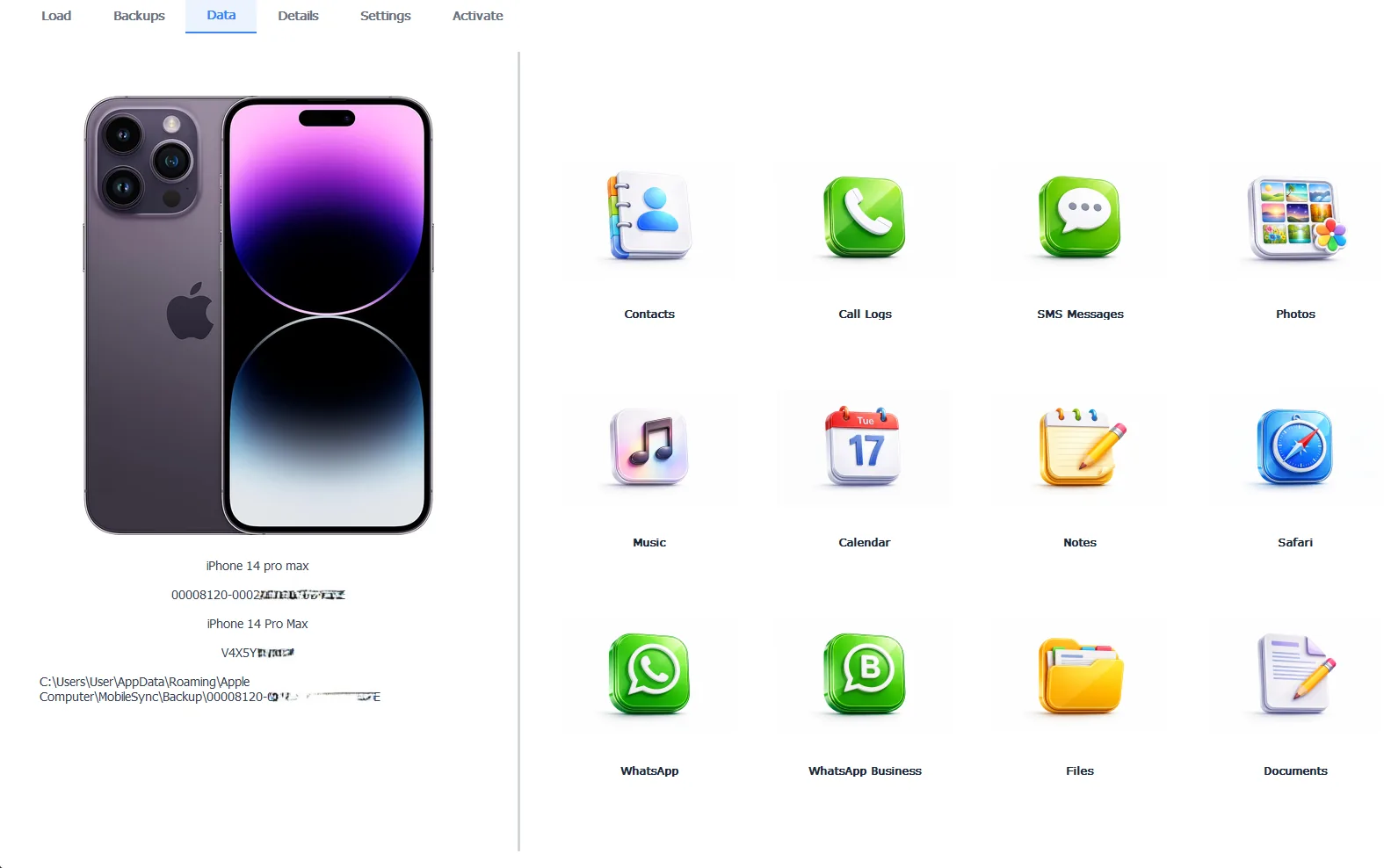
The computer backup, open and readable by category. iCloud offers no equivalent view
This is why the computer backup earns the archive role. A lost phone, a deleted conversation or a photo hunt from three years back all run through the backup you can actually open. The free version previews everything, and the Pro edition at $49 per year unlocks exports, with everything running 100% locally.
Free version previews your backup contents. Works on Windows 10 and 11.
“People frame it as a rivalry, and the two backups can’t even do each other’s jobs. iCloud protects you automatically while you sleep. The computer backup is the only one you can open, browse and pull a single conversation out of. One is insurance. The other is an archive. Run both and stop choosing.”
Viralkumar Patel in | iData Backup Viewer Team, CYBERSICS SOLUTIONS
Which Should You Use?
Just want set and forget protection? iCloud, and accept the subscription. Automatic overnight backups beat the manual routine you’ll eventually skip.
Watching costs, or holding a big phone? The computer backup, free at 60GB the same as at 6GB. Build the habit of connecting weekly and before every iOS update.
Want your data readable, searchable and extractable? The computer backup is the only game in town. iCloud’s seal never opens.
Want the honest best answer? Both. iCloud catches the days you forget, and the computer backup gives you the free readable archive plus the fast restore. Each one covers exactly what the other can’t do, which is the opposite of a rivalry.
So skip the sports team framing. Let iCloud run its quiet overnight insurance, keep a computer backup as the archive you can open, and the iTunes backup vs iCloud backup debate dissolves into a two line setup checklist.
Which half of that checklist is your iPhone missing today?
Frequently Asked Questions
Can I use both iTunes and iCloud backup?
Yes, and it’s the strongest setup there is. iCloud backs up automatically overnight while the computer backup gives you a free, readable archive you control. Each one covers the other’s blind spot.
Is iCloud backup safer than a computer backup?
They carry different risks rather than more or less risk. A computer backup dies with a stolen laptop or a failed drive. An iCloud backup depends on your subscription and your Apple Account staying healthy. Both encrypt your data. Running both beats debating them.
Can I browse the files inside my iCloud backup?
No. An iCloud backup restores onto an iPhone and does nothing else. There’s no browsing it on a PC, no pulling out one conversation and no checking what it holds. Restore is the entire feature.
Does the computer backup include my photos?
Only when iCloud Photos is off. With it on, Apple syncs your library to iCloud and leaves it out of every backup, computer and iCloud alike, since it’s already stored in iCloud.
Which backup is better for moving to a new iPhone?
Both work through a full restore. The cable makes the computer restore faster, while the iCloud restore works anywhere with Wi-Fi and patience. Pick by whether the old backup you trust lives on your PC or in iCloud.
Do I have to pay for iTunes backups?
No. Computer backups are free at any size, limited only by your drive space. When old snapshots pile up, clearing them safely takes minutes and returns the space.
Written by Viralkumar Patel in
Viralkumar works on iData Backup Viewer at CYBERSICS SOLUTIONS, where he helps Windows users read, recover and export data from iPhone backups.