How to Recover Deleted iMessages from an iPhone Backup



Deleted a conversation you needed and now you’re searching in a mild panic? Take a breath. There are two real ways to recover deleted iMessages, and the right one depends on how long ago you deleted them and whether a backup exists. This guide covers both, plus the one mistake that destroys your last chance.
Summary
To recover deleted iMessages, check the Recently Deleted folder in the Messages app first. It holds messages for 30 days, and in some cases up to 40. Past that window, an iTunes backup made before the deletion is your best route, and you can extract the messages on a PC without restoring the iPhone.
| Recovery Route | Works When | Wipes Your Phone? |
|---|---|---|
| Recently Deleted folder | Deleted within the last 30 to 40 days on iOS 16 or later | No |
| Extract from an iTunes backup | A backup on your PC predates the deletion | No |
| Full restore of an old backup | Same as above, and you accept losing newer data | Yes, replaces everything |
| Deep scan for deleted fragments | Deleted rows in the backup database aren’t overwritten yet | No |
Table of Contents
Can Deleted iMessages Actually Be Recovered?
Yes, in two windows. The first is Apple’s own safety net. Since iOS 16, deleted messages sit in a Recently Deleted folder for 30 days, and in some cases up to 40, before they’re gone from the phone.
The second window is bigger than most people realize. Your iPhone stores messages in a database file, and deleting a message marks its row as reusable space rather than erasing it on the spot. A backup made before or shortly after the deletion carries that database, frozen in time. Until new data overwrites those rows, the messages are still physically in there.
This is why the same conversation can be invisible on your phone and readable inside a three month old backup sitting on your PC.
Check Recently Deleted on Your iPhone First
Always start with the free route. It takes under a minute.
- Open the Messages app on your iPhone.
- Tap Edit in the top left corner, or the Filters icon.
- Tap Show Recently Deleted.
- Select the conversations you want back, then tap Recover.
- Confirm with Recover Messages.
Apple documents the exact steps and limits in its guide on recovering deleted text messages. Two hard limits apply. You need iOS 16 or later, and messages removed with Undo Send skip this folder entirely and are gone for good.
If your messages aren’t in Recently Deleted, don’t touch the phone further. Read the next section before you do anything else.
Stop. Do Not Back Up Your iPhone Right Now
Here’s the mistake that ends recovery attempts for good. iTunes and the Apple Devices app keep one backup per device and refresh it on the next sync. Your old backup doesn’t sit safely next to the new one. It gets replaced.
So if the only snapshot containing your deleted messages is the backup on your PC, plugging the phone in and letting it back up overwrites that snapshot with the current state of the phone, where the messages no longer exist.
Protect the backup before you connect anything
Copy the entire device backup folder to another location on your PC first. Our guide on where iPhone backups are stored on Windows shows both possible folders. Once a copy exists, nothing iTunes does can take your messages away.
“The most painful cases we see are people who plugged the phone in to go looking for their old messages, and iTunes quietly refreshed the backup during the session. The one snapshot holding the deleted texts got overwritten while they watched. If deleted data matters to you, copy the backup folder before you connect anything.”
Viralkumar Patel in | iData Backup Viewer Team, CYBERSICS SOLUTIONS
How Do You Recover Deleted iMessages from an iPhone Backup?
The full restore route works, and it costs you everything created since the backup. A restore replaces the phone’s entire contents with the old snapshot. Extraction is the smarter path. iData Backup Viewer opens the backup on Windows 10 and 11, runs a deep scan for deleted message fragments and lets you export just the conversations you need. Your iPhone stays untouched.
- Download and install iData Backup Viewer on the PC holding the backup.
- Launch the app. It detects backups in both Windows locations on its own.
- Select the backup made before the deletion. Enter the password if it’s encrypted.
- Open the Messages category. Existing and recovered deleted messages appear together in the preview.
- Export the conversations you need as PDF, HTML or CSV.
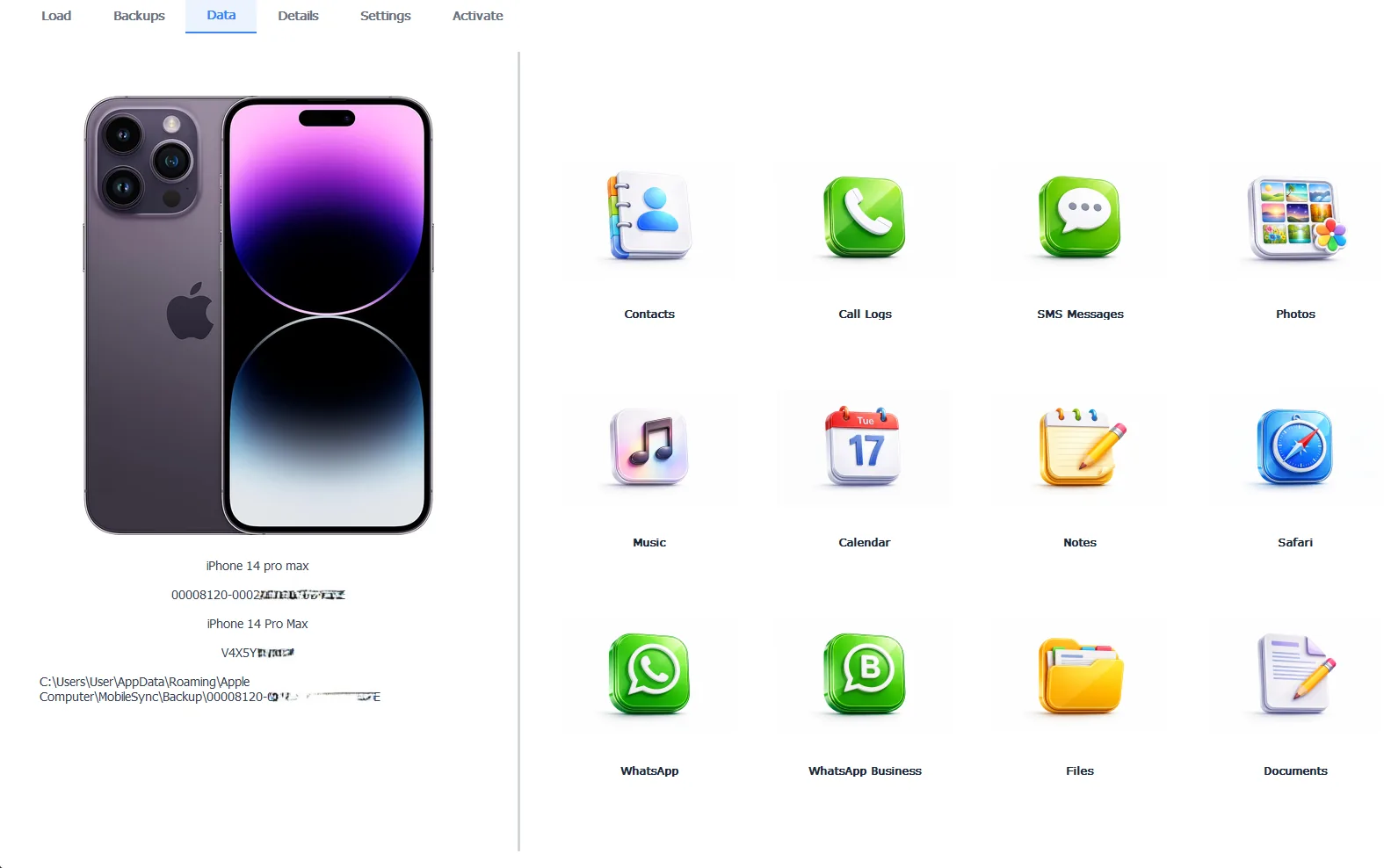
Step 4: iData Backup Viewer showing message data recovered from an iPhone backup
The free version shows you the scan results first, so you know whether your messages survived before spending anything. The Pro edition at $49 per year unlocks the exports, and everything runs 100% locally on your PC.
Free version previews your backup contents. Works on Windows 10 and 11.
What Are Your Real Odds?
Honesty first. No tool can promise recovery, ours included. Four factors decide your odds.
When the backup was made. A backup created before the deletion contains the messages fully intact, with certainty. A backup made after the deletion relies on the deep scan finding rows that haven’t been overwritten yet.
How active the phone was after deleting. Heavy messaging after the deletion fills the freed database space with new content. Less activity means better odds.
Whether Messages in iCloud is on. With it enabled, your message history lives in iCloud rather than fully inside the local backup, and deletions sync to every device on your Apple Account. Both effects shrink what a backup scan can recover.
Encryption is not a problem. An encrypted backup scans the same as any other once you enter its password. Without the password, nothing can open it. That’s a hard wall, and we covered more of these edge cases in our guide on the corrupt or not compatible backup error.
What If Nothing Works?
Three last options remain. Ask the other person in the conversation to export their copy, since messages exist on both ends. Contact your carrier for SMS records, keeping in mind carriers hold plain text messages briefly and never iMessages, which are encrypted end to end. And going forward, turn on regular backups so the next accident has a safety net waiting.
So the playbook is short. Check Recently Deleted within the 30 day window. Past that, protect the backup on your PC before the phone touches iTunes again, then extract the messages on Windows instead of gambling your current data on a full restore.
Which backup on your PC is old enough to still hold your deleted conversation?
Frequently Asked Questions
Can I recover deleted iMessages after 30 days?
Recently Deleted won’t help past its window, but a backup can. If an iTunes backup on your PC was made before you deleted the messages, those messages sit inside it and a backup viewer reads them out without touching your phone.
Does restoring a backup delete my current data?
A full restore does. It replaces everything on the iPhone with the backup’s contents, so you lose every photo and message created since that backup. Extracting messages on your PC avoids this completely because the phone is never involved.
Do deleted messages stay inside the backup file?
In many cases, yes. Messages live in a database, and deleting a message marks its row as free space instead of erasing it instantly. Until new data overwrites that space, a deep scan of the backup can still pull the message out.
Can I recover a message removed with Undo Send?
No. Apple states that messages removed with Undo Send are permanently deleted. They never reach Recently Deleted, so no recovery method applies to them.
Does Messages in iCloud affect recovery?
Yes, in two ways. Deleting a message syncs the deletion to every device on your Apple Account. And with Messages in iCloud turned on, your messages live in iCloud rather than fully inside the local iTunes backup, which shrinks what a backup scan can find.
Can iData Backup Viewer recover deleted photos too?
Yes. The same deep scan that finds deleted message fragments also looks for recently deleted photos inside the backup. Whatever the scan surfaces appears in the free preview before you pay for exports.
Written by Viralkumar Patel in
Viralkumar works on iData Backup Viewer at CYBERSICS SOLUTIONS, where he helps Windows users read, recover and export data from iPhone backups.