What Does an iPhone Backup Not Include? (2026)



What does an iPhone backup not include catches people right after a restore. The music is gone. So is Screen Time, plus a few app logins. Nothing broke. Those items were never in the file to begin with. The excluded list turns out to be short and logical: anything Apple can redownload for you, anything already saved in iCloud and, unless you encrypt, a handful of sensitive items. Knowing the list before you rely on it saves the nasty surprise after a restore.
Quick Answer
An iPhone backup does not include content it can redownload or data already stored elsewhere. Left out are apps themselves, music and media synced from iTunes, anything synced to iCloud like iCloud Photos, and, unless the backup is encrypted, Health, Activity and Keychain data. A backup saves what cannot be easily recovered another way.
| Left Out of the Backup | Why It’s Out and Where It Lives |
|---|---|
| Apps themselves | Redownloaded from the App Store, data kept |
| Music, podcasts, movies | Resynced or redownloaded from the store |
| iCloud-synced data | Already stored in iCloud |
| Health, Keychain, Screen Time | Only in encrypted backups |
Table of Contents
What an iPhone Backup Leaves Out and Why
One rule explains the entire exclusion list. A backup leaves out anything it can get back another way. If Apple can redownload it from a store or it already sits in iCloud, the file skips it to avoid storing the same data twice. That keeps the backup smaller and faster while still protecting the data that is genuinely hard to replace.
So the backup is not a photo of every byte on the phone. It is a smart copy of the hard-to-replace parts, messages, photos you took, contacts, call history, app data and settings, the full contents listed in our breakdown of what is inside an iPhone backup. Everything excluded falls into three buckets, covered next.
Apps, Music and Anything Redownloadable
The first bucket is content Apple can fetch again. The apps themselves are not in the backup. The backup records which apps were installed, then redownloads them from the App Store during a restore while bringing back their data, your logins, progress and documents. This is why app icons sometimes show a loading bar after a restore, covered in our guide to data missing after an iPhone restore.
Media follows the same rule. Music, podcasts, ringtones and movies from the iTunes Media Library stay out, since they resync from a computer or redownload from the store. The same goes for content bought from the iTunes and App Stores and PDFs saved to Apple Books. None of it is lost. All of it comes back from its source rather than from the backup.
Anything Already in iCloud
The second bucket is data that already lives in iCloud. If a category syncs to iCloud, the local backup leaves it out, because iCloud is already holding it. The biggest example is photos. With iCloud Photos turned on, your library lives in iCloud and drops out of the local backup entirely, one of the main reasons a backup can look surprisingly small, explained in our guide to why an iPhone backup is so large.
The same applies to iCloud-synced Messages, Notes, Contacts and Calendar. Files in iCloud Drive count too. All of it is reachable at iCloud.com with your Apple ID rather than inside the backup. The split between what iCloud holds and what a computer backup holds is mapped in our comparison of iTunes backup versus iCloud backup.
What Only an Encrypted Backup Keeps
The third bucket is the one that catches people. An unencrypted iPhone backup leaves out four sensitive things that an encrypted backup keeps.
- Health data from the Health app.
- Activity data from fitness tracking.
- Keychain saved passwords and Wi-Fi logins.
- Screen Time settings and passcode.
Restore an unencrypted backup and those four come back empty, which surprises people who assumed everything was saved. The fix is one checkbox. Turn on Encrypt Local Backup when you back up, following our guide to backing up an iPhone to a computer. All four then ride along. Encryption adds data rather than removing it, the opposite of what many expect.
“The exclusions trip people up only because the logic is invisible. A backup skips what Apple can get back for free and what iCloud already holds. The one real trap is the unencrypted backup, which quietly drops Health and passwords. Tick the encrypt box once and that trap closes. Everything else excluded was never at risk.”
Viralkumar Patel in | iData Backup Viewer Team, CYBERSICS SOLUTIONS
What This Means Before You Restore
Three practical takeaways follow from the list. First, encrypt your backups, so Health, passwords and Screen Time are actually in them. Second, do not panic when music or apps look missing after a restore, since those redownload from their source on their own. Third, remember that iCloud-synced data comes back through iCloud sign-in, not through the backup, so sign into the right Apple ID to pull it down.
The surest way to know what a backup holds is to open it and look. iData Backup Viewer opens a backup on Windows 10 or 11 and shows every category actually inside it, free to browse, so you can confirm your messages, photos and contacts are there before trusting the backup. Seeing the real contents beats guessing from a feature list. The full map of recovery, included data and excluded data lives in our iPhone data recovery hub.
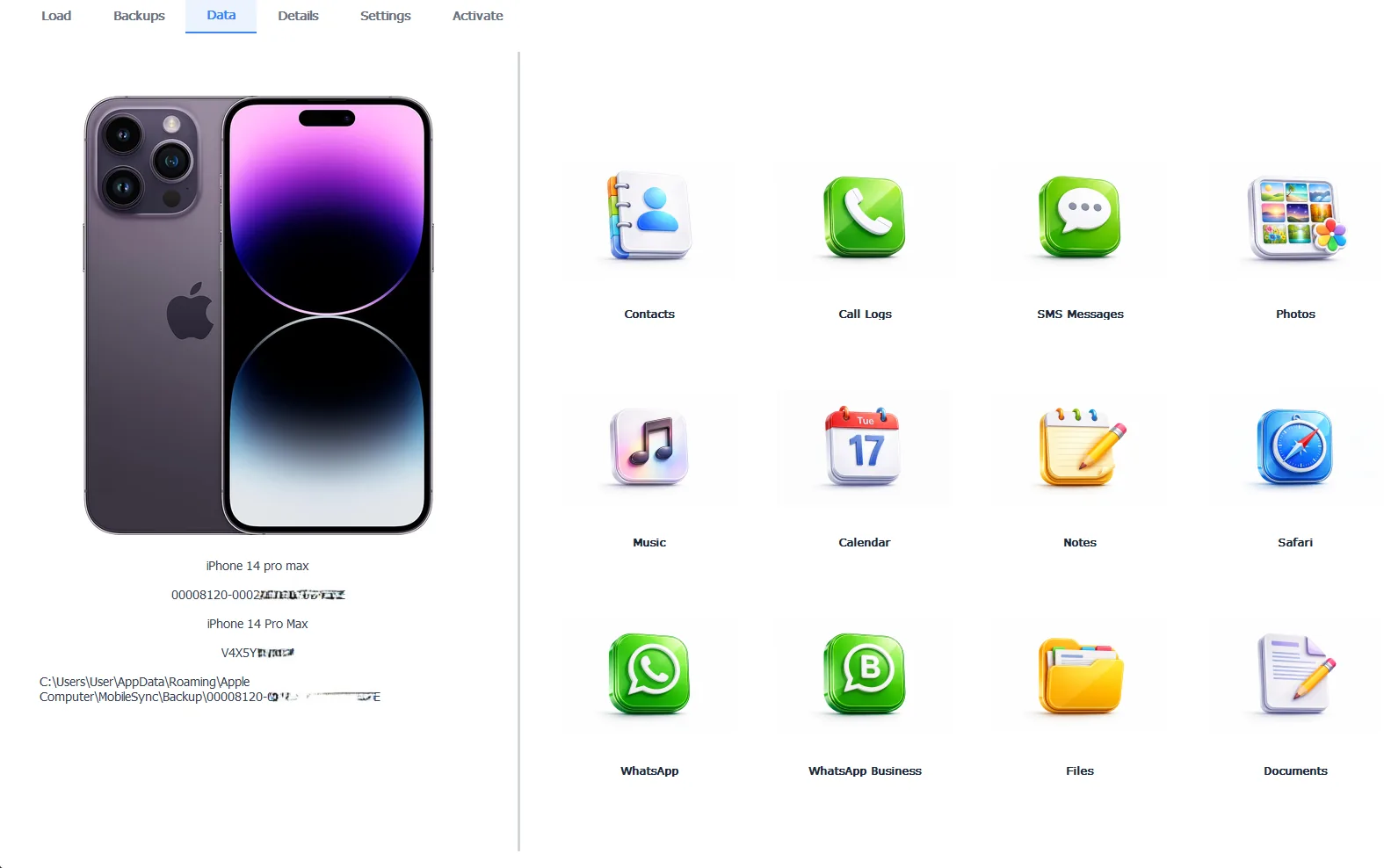
The categories a backup does hold, confirmed by opening it
Free version previews your backup contents. Works on Windows 10 and 11.
What an iPhone backup leaves out comes down to a few plain points:
- Apps, music and store content are excluded, since they redownload from their source.
- iCloud-synced data is excluded, since it already lives in iCloud.
- Health, Keychain, Activity and Screen Time are excluded unless the backup is encrypted.
- Everything hard to replace, messages, photos, contacts, is kept, so encrypt and verify.
Is your backup encrypted or are Health and your passwords quietly missing from it?
Frequently Asked Questions
Does an iPhone backup include apps?
An iPhone backup saves app data but not the apps themselves. It records which apps were installed, then redownloads them from the App Store during a restore. Your progress, logins and app documents come back, while the app files are fetched fresh.
Does an iPhone backup include music?
No. Music and other iTunes Media Library content like podcasts, ringtones and movies stay out of the backup, since they can be resynced from a computer or redownloaded from the store. The backup skips anything redownloadable to save space.
Are my photos in the iPhone backup?
It depends on iCloud Photos. With iCloud Photos off, the camera roll is in the backup. With iCloud Photos on, the library lives in iCloud and is left out of the local backup, reachable at iCloud.com instead.
What does an unencrypted backup leave out that an encrypted one keeps?
An unencrypted iPhone backup leaves out Health data, Activity data, Keychain saved passwords and the Screen Time passcode. An encrypted backup includes all of those. Turning on encryption is the one setting that closes this gap.
Does the iPhone backup include iCloud data?
No. Anything already synced to iCloud stays out of the local backup, since it already lives in iCloud. That covers iCloud Photos, iCloud-synced Messages, Notes and Contacts, plus files in iCloud Drive.
Why does Apple leave these things out of the backup?
To avoid storing the same data twice. Content that redownloads from a store or already sits in iCloud does not need a second copy in the backup, so Apple excludes it. The result is a smaller backup of the data that is genuinely hard to replace.
Written by Viralkumar Patel in
Viralkumar works on iData Backup Viewer at CYBERSICS SOLUTIONS, where he helps Windows users read, recover and export data from iPhone backups.
Last updated September 2026