What Is Inside an iPhone Backup and How to View the Files



Open an iPhone backup folder and you’ll find thousands of files with meaningless names and no extensions. Somewhere in that pile sit your messages, your photos and a decade of digital life. This guide explains what is inside an iPhone backup, file by file and data type by data type, and how to turn the whole pile back into something you can read.
Summary
An iPhone backup holds your messages, WhatsApp chats, contacts, call history, notes, Safari data and app documents as hashed files indexed by a database called Manifest.db. Photos join only when iCloud Photos is off, and Health data plus passwords join only when the backup is encrypted. A backup viewer reads it all on Windows.
| Data Type | In the Backup? | Notes |
|---|---|---|
| iMessages and SMS | Yes | Full history, unless Messages in iCloud is on |
| WhatsApp chats and attachments | Yes | Complete history when WhatsApp is installed |
| Photos and videos | Conditional | Included only when iCloud Photos is off |
| Contacts and call history | Yes | Full lists with timestamps |
| Notes, calendars, voice memos | Yes | Unless synced to iCloud instead |
| Safari history and bookmarks | Yes | Browsing data rides along |
| App documents and settings | Yes | Data only, the apps re-download from the store |
| Health, Activity, saved passwords | Encrypted only | Left out of unencrypted backups by design |
| Apps, music, store purchases | No | They re-download from their sources |
| Anything synced to iCloud | No | iCloud Photos and similar live in iCloud, not here |
Table of Contents
- What Is an iPhone Backup, Technically?
- What Data Types Are Inside an iPhone Backup?
- What’s Only in Encrypted Backups?
- What’s Never in the Backup?
- How Is a Computer Backup Different from an iCloud Backup?
- How Do You View iPhone Backup Files?
- How Big Is a Backup and Where Does It Live?
- Which Data Can You Extract Individually?
- How Do You Read a Backup When the iPhone Is Gone?
- Can You Edit or Delete Files Inside a Backup?
- What Mistakes Ruin Backups?
- Frequently Asked Questions
What Is an iPhone Backup, Technically?
A backup is one folder per device, named with a long identifier called a UDID. Inside, your data hides in plain sight. Every file from the phone is stored under a 40 character hashed name with no extension, and since iTunes 12.5.5 those files spread across 256 two character subfolders to keep any single directory manageable.
Three small files hold the keys to the kingdom. Manifest.db is a database mapping every hashed name back to its original file and app. Info.plist records the device details, its name, model and iOS version. Status.plist records whether the backup finished cleanly.
This design explains everything confusing about backups. Double clicking a hashed file does nothing because the file’s identity lives in the manifest, not in its name. And when the manifest gets damaged, iTunes declares the whole backup corrupt even while thousands of intact files sit right there, which is exactly the situation our guide on the corrupt or not compatible backup error untangles.
“People expect a backup to look like a phone’s file system, folders of photos and documents with names. It’s closer to a sealed shipping container with a manifest. Every item is inside, packed under a code name, and one manifest file knows what’s what. Learn to read the manifest and the whole container opens.”
Viralkumar Patel in | iData Backup Viewer Team, CYBERSICS SOLUTIONS
What Data Types Are Inside an iPhone Backup?
The table above gives the quick answer. Here’s what each category means in practice when you open the backup.
Messages. Your iMessage and SMS history sits in a single database with every conversation, timestamp and attachment reference. It’s the richest data in the backup, and it’s also where deleted content can linger, as our guide on recovering deleted iMessages explains in depth.
WhatsApp. The full chat history with attachments comes along whenever WhatsApp is installed at backup time. This surprises people who assume WhatsApp lives only in its own cloud backup, and it’s the basis of the method in our guide on exporting WhatsApp chats from an iPhone backup.
Photos and videos. The conditional one. With iCloud Photos off, your entire camera roll is in the backup at original quality. With it on, the originals live in iCloud instead, the single most misunderstood rule in this whole subject and the focus of our guide on extracting photos from an iPhone backup.
Contacts and call history. Both arrive complete, with numbers, names and timestamps. For anyone rebuilding a lost phone’s contact list, these two databases alone justify the backup.
Notes, calendars and voice memos. Present when they sync to the phone rather than to iCloud. Voice memos arrive as playable audio files.
Safari data. History and bookmarks ride along, which matters more than people expect when a research trail or a saved link needs recovering.
App data. Documents, settings and saves from your apps are in the backup. The apps themselves aren’t, since they re-download from the App Store during a restore.
What’s Only in Encrypted Backups?
Three categories join the backup only when you tick Encrypt local backup before backing up. Health data, Activity history and your Keychain of saved passwords. An unencrypted backup skips all three by design, so the checkbox quietly decides whether years of health records survive a phone loss.
The tradeoff is absolute. An encrypted backup opens only with its password, and neither Apple nor any tool can reset that password for an existing backup. Our guide on backing up an iPhone to a computer covers setting encryption up properly, including where to keep the password.
What’s Never in the Backup?
Apple’s rule is consistent, and it’s written down in the official backup methods guide. Anything that already syncs to iCloud stays out of the computer backup, because storing it twice would waste space. iCloud Photos tops the list, followed by Messages in iCloud when that feature is on.
Apps, music and other store purchases also stay out, since they re-download from their sources. So a backup is smaller than the phone’s used storage, and a restore needs internet access to finish rebuilding everything the backup deliberately skipped.
How Is a Computer Backup Different from an iCloud Backup?
Both snapshots serve the same restore purpose, and they live very different lives. The computer backup sits on your own drive, costs nothing at any size and opens with a viewer whenever you want to look inside. The iCloud backup sits on Apple servers, counts against your paid storage plan past the free 5GB and never opens for browsing at all. Restoring is the only thing iCloud lets you do with it.
Contents differ too. The iCloud backup leans harder on the sync rule, since so much of your data already lives in iCloud alongside it. The computer backup captures more in one place, especially with encryption on. That’s why the readable archive strategy in this guide runs through the computer, and why setting one up is worth ten minutes, as covered in our walkthrough on backing up an iPhone to a computer.
The two aren’t rivals. iCloud protects you automatically overnight, and the computer backup gives you an archive you control and can actually read. Run both and each covers the other’s blind spot.
How Do You View iPhone Backup Files?
File Explorer can’t do it, for the manifest reasons above. A backup viewer can. iData Backup Viewer reads Manifest.db, rebuilds the original structure and presents everything by category on Windows 10 and 11, encrypted backups included once you enter the password.
- Download and install iData Backup Viewer on the PC holding the backup.
- Launch it. Backups in both Windows locations appear on their own.
- Select your device and enter the backup password if asked.
- Browse messages, WhatsApp, photos, contacts, call history, notes and Safari data as readable categories.
- Export whatever you pick as PDF, HTML, CSV or original files.
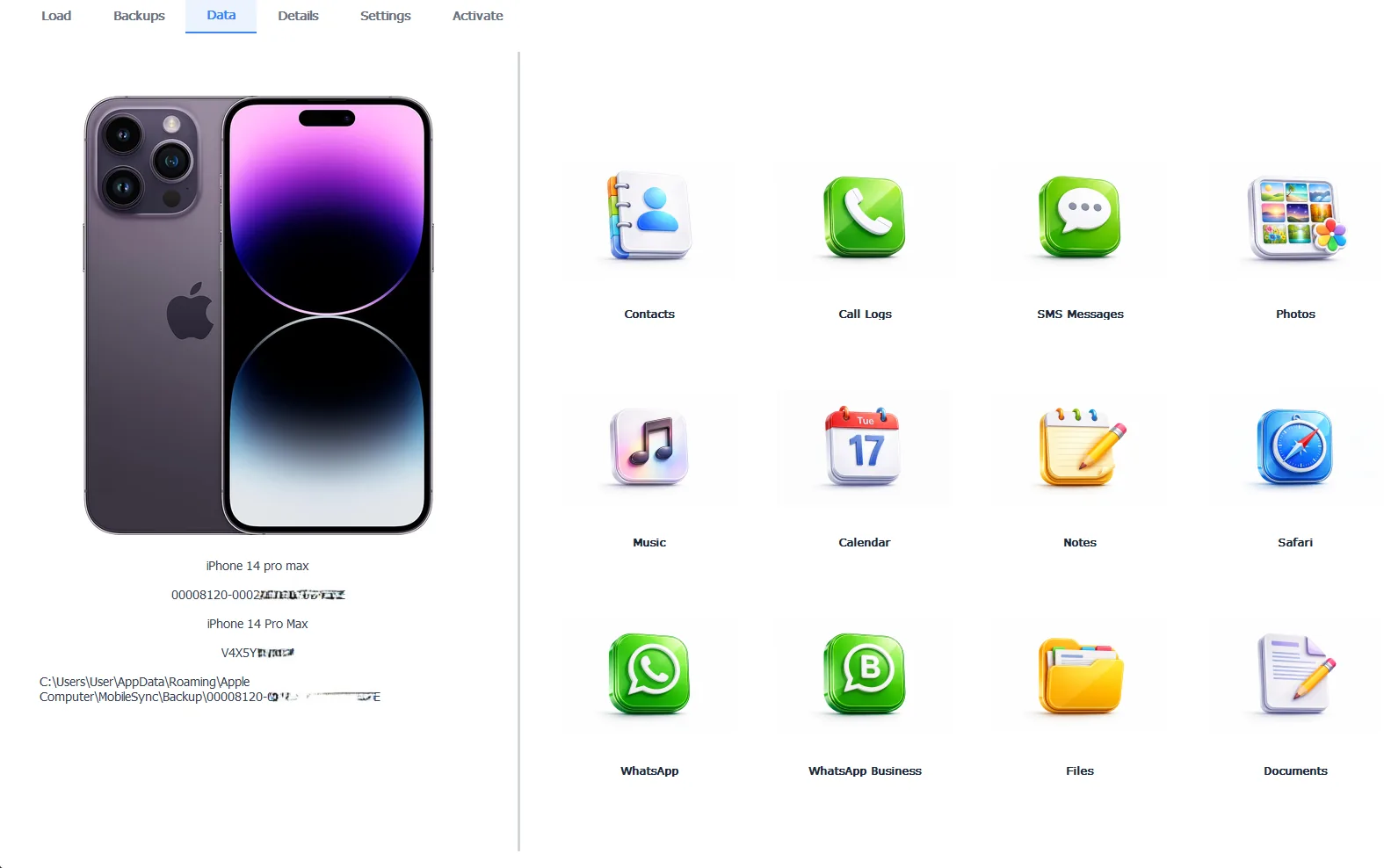
Step 4: iData Backup Viewer displaying backup contents as readable categories
The free version previews the entire backup, so the question of what your backup holds gets answered before any payment. The Pro edition at $49 per year unlocks exports, everything stays 100% local and the backup itself is opened read only. We compared the other tools for this job honestly in our iMazing alternatives guide.
Free version previews your backup contents. Works on Windows 10 and 11.
How Big Is a Backup and Where Does It Live?
Expect tens of gigabytes. A full modern iPhone commonly produces a backup past 20GB, shrinking with everything iCloud already holds. The folder lands in one of two hidden locations depending on which app made it, both covered with shortcuts in our guide on where iPhone backups are stored on Windows.
One behavior shapes everything else. iTunes and the Apple Devices app keep a single backup per device and replace it on the next run. Snapshots you care about need copying aside manually before the next sync, a two minute habit that has saved more deleted messages than any recovery tool ever will.
Checking a backup’s size takes one right click. Open the Backup folder, right click the device folder and pick Properties. A folder measured in gigabytes with a recent modified date is a living backup. A folder of a few megabytes signals a backup that started and never finished, worth investigating before you rely on it.
Size also tells a story across time. A backup that shrank dramatically since last month points at iCloud Photos getting switched on, moving your library out of the local snapshot. Nothing broke, the rules just changed underneath you, and the Properties window is the cheapest early warning you’ll get.
Which Data Can You Extract Individually?
All of it, and this is the part Apple never built. Apple’s own restore is all or nothing, the whole backup onto the whole phone, wiping what’s currently there. Extraction flips that. You pull three conversations, one album or a single contact out of the backup on your PC while the phone stays untouched.
Messages export as PDF or HTML with timestamps intact. WhatsApp chats come out with attachments in place. Photos copy out at original quality. Contacts land as VCF or CSV ready to import anywhere. When the goal really is rebuilding an entire phone, our guide on restoring an iPhone from a backup covers the full restore routes instead.
How Do You Read a Backup When the iPhone Is Gone?
Here’s the quiet superpower of the whole format. A backup needs no phone. It’s a self contained folder, so a lost, stolen, drowned or dead iPhone changes nothing about reading it. The PC holds the data, and the viewer opens it exactly as if the phone still existed.
The folder is portable too. Copy the device folder to an external drive or a new PC and it opens there the same way, password included for encrypted backups. Families use this after a phone is gone for good, pulling out the messages and photos that mattered from the last snapshot. Our guide on viewing iPhone messages on a PC walks through that exact scenario.
The one thing a backup can’t do without the phone is grow. It’s frozen at its creation date, which makes the archiving habit from earlier worth repeating. The last backup before a phone disappears becomes the most valuable folder on your PC.
Can You Edit or Delete Files Inside a Backup?
Viewing is safe. Editing is destruction. Every file inside the device folder is accounted for in Manifest.db, and a restore validates that accounting.
Never modify individual files inside a backup
Renaming, editing or deleting single hashed files breaks the match against Manifest.db and can make the entire backup fail to restore. Delete whole device folders when clearing space, never their contents, and keep a copy elsewhere first when the data matters.
What Mistakes Ruin Backups?
Four errors account for nearly every backup tragedy we hear about, and every one of them is preventable.
Syncing over the only good snapshot. One backup per device means the next sync replaces the last. When a backup holds deleted messages or a lost phone’s final state, copy the folder aside before any device touches iTunes again.
Assuming the photos are in there. With iCloud Photos on, they aren’t, and discovering that after the phone is gone is brutal. Check the setting today, while checking costs nothing.
Losing the encryption password. It protects Health data and passwords precisely because nothing can bypass it, your own forgetfulness included. Write it down the day you set it.
Cleaning up inside the backup folder. Deleting a few of those meaningless looking files to save space guts the manifest match and kills the restore. Space cleanup means removing whole device folders, nothing smaller.
So the mystery pile of files turns out to be organized after all, just organized for machines instead of people. Messages, WhatsApp, contacts and app data are always inside. Photos depend on one iCloud setting, Health and passwords depend on one encryption checkbox, and a single manifest database holds the map to all of it. Reading that map is a solved problem on Windows.
Now that you know what your backup holds, which part of your digital life do you want to see first?
Frequently Asked Questions
Can I open iPhone backup files without special software?
No. The files carry 40 character hashed names with no extensions, and only the Manifest.db database knows which is which. File Explorer shows the container, not the contents. A backup viewer translates the manifest and rebuilds the readable data.
Are my saved passwords in the backup?
Only in encrypted backups. Tick Encrypt local backup before backing up and your Keychain passwords, Health data and Activity history come along. Skip it and Apple leaves all three out by design.
Does the backup contain deleted data?
Fragments can survive. Deleting a message or photo marks database space as reusable rather than wiping it, so a deep scan of the backup can surface items the phone no longer shows, as long as new data hasn’t overwritten them.
Can I copy the backup folder to another PC and read it there?
Yes. A backup is an ordinary folder of files, so it moves like one. Copy the entire device folder to a drive or another PC and a backup viewer opens it there, with the password if it’s encrypted.
Why are the files named with 40 characters?
Each file is stored under a hash of its original path, which keeps names unique and consistent. The tradeoff is that humans can’t read them, which is exactly why the Manifest.db index exists.
Is it safe to open a backup with a viewer?
Yes. A viewer reads the files without writing anything into the folder, so the backup stays byte for byte as iTunes left it and remains fully valid for a future restore.
Written by Viralkumar Patel in
Viralkumar works on iData Backup Viewer at CYBERSICS SOLUTIONS, where he helps Windows users read, recover and export data from iPhone backups.