Where Are iPhone Backups Stored on Windows 10 and 11?



Backed up your iPhone on a PC and now you can’t find where Windows put it? You’re not alone. Apple hides the backup folder inside a hidden directory, and the path changes depending on which app made the backup. Here’s the exact location, plus how to open and read what’s inside.
Summary
iPhone backups are stored at C:\Users\[username]\AppData\Roaming\Apple Computer\MobileSync\Backup on Windows 10 and 11 when you use desktop iTunes. The Microsoft Store version of iTunes and the Apple Devices app save them to C:\Users\[username]\Apple\MobileSync\Backup instead. Both folders are hidden by default.
| Backup App | Backup Location on Windows |
|---|---|
| Desktop iTunes (apple.com download) | C:\Users\[username]\AppData\Roaming\Apple Computer\MobileSync\Backup |
| Microsoft Store iTunes | C:\Users\[username]\Apple\MobileSync\Backup |
| Apple Devices app (Windows 11) | C:\Users\[username]\Apple\MobileSync\Backup |
Table of Contents
- What Is the Exact iPhone Backup Location on Windows?
- How Do You Open the Backup Folder in Seconds?
- Why Do the Backup Files Look Unreadable?
- How Do You View What Is Inside an iPhone Backup?
- Can You Move iPhone Backups to Another Drive?
- What If the Backup Folder Is Empty or Missing?
- Frequently Asked Questions
What Is the Exact iPhone Backup Location on Windows?
Two different apps can create iPhone backups on Windows, and they use two different folders. This is the single most common reason people think their backup vanished.
Desktop iTunes, the version downloaded from apple.com, writes to the AppData path shown in the table above. In contrast, the Microsoft Store version of iTunes and the newer Apple Devices app both write to the Apple\MobileSync folder directly under your user profile. Apple confirms both locations in its official guide, Locate backups of your iPhone, iPad, and iPod touch.
The AppData folder is hidden by default. Because of this, you won’t spot it while clicking through C:\ manually. File Explorer needs Show hidden items turned on, or you can jump straight there with the shortcut in the next section.
Inside the Backup folder, each device gets its own subfolder named with a long string of letters and numbers called a UDID. For example, if you backed up two iPhones and an iPad on the same PC, you’ll see three of these folders sitting side by side.
How Do You Open the Backup Folder in Seconds?
The fastest route takes about five seconds. Skip the manual clicking and use the Run dialog instead.
For desktop iTunes
- Press Win+R on your keyboard.
- Type %appdata%\Apple Computer\MobileSync and press Enter.
- Open the Backup folder inside.
For Microsoft Store iTunes or the Apple Devices app
- Press Win+R.
- Type %USERPROFILE%\Apple\MobileSync and press Enter.
- Open the Backup folder.
If one path turns up empty, check the other. Because both apps can live on the same PC, backups sometimes end up split across the two locations.
Why Do the Backup Files Look Unreadable?
Open any device folder and you’ll see hundreds of files with 40 character names and no file extensions. There’s nothing wrong with your backup. Apple stores every file under a hashed name and keeps the real file list inside a database called Manifest.db. File Explorer can’t read that database, so the folder looks like random noise.
Your photos, messages and contacts are all in there. They’re just indexed in a format Windows was never built to display. As a result, double clicking any of these files gets you nowhere.
Do not touch individual backup files
Never rename, move or delete single files inside a device backup folder. iTunes checks every file against Manifest.db during a restore, and one missing file can make the entire backup fail to restore.
“Half the support requests we see start with someone who found the Backup folder and assumed it was corrupt, because every file is a 40 character name with no extension. The backup is almost always fine. Apple just stores it in a database format that File Explorer was never meant to read.”
Viralkumar Patel in | iData Backup Viewer Team, CYBERSICS SOLUTIONS
How Do You View What Is Inside an iPhone Backup?
You need a backup viewer to translate those hashed files back into messages, photos and contacts. iData Backup Viewer does exactly this on Windows 10 and 11. It reads Manifest.db, rebuilds the original file structure and shows your data sorted by category.
- Download and install iData Backup Viewer.
- Launch the app. It scans both backup locations automatically, so you skip the folder hunt entirely.
- Pick your device from the detected list.
- Enter your backup password if the backup is encrypted.
- Browse iMessages, WhatsApp chats, photos, contacts, call history and notes. Export what you need.
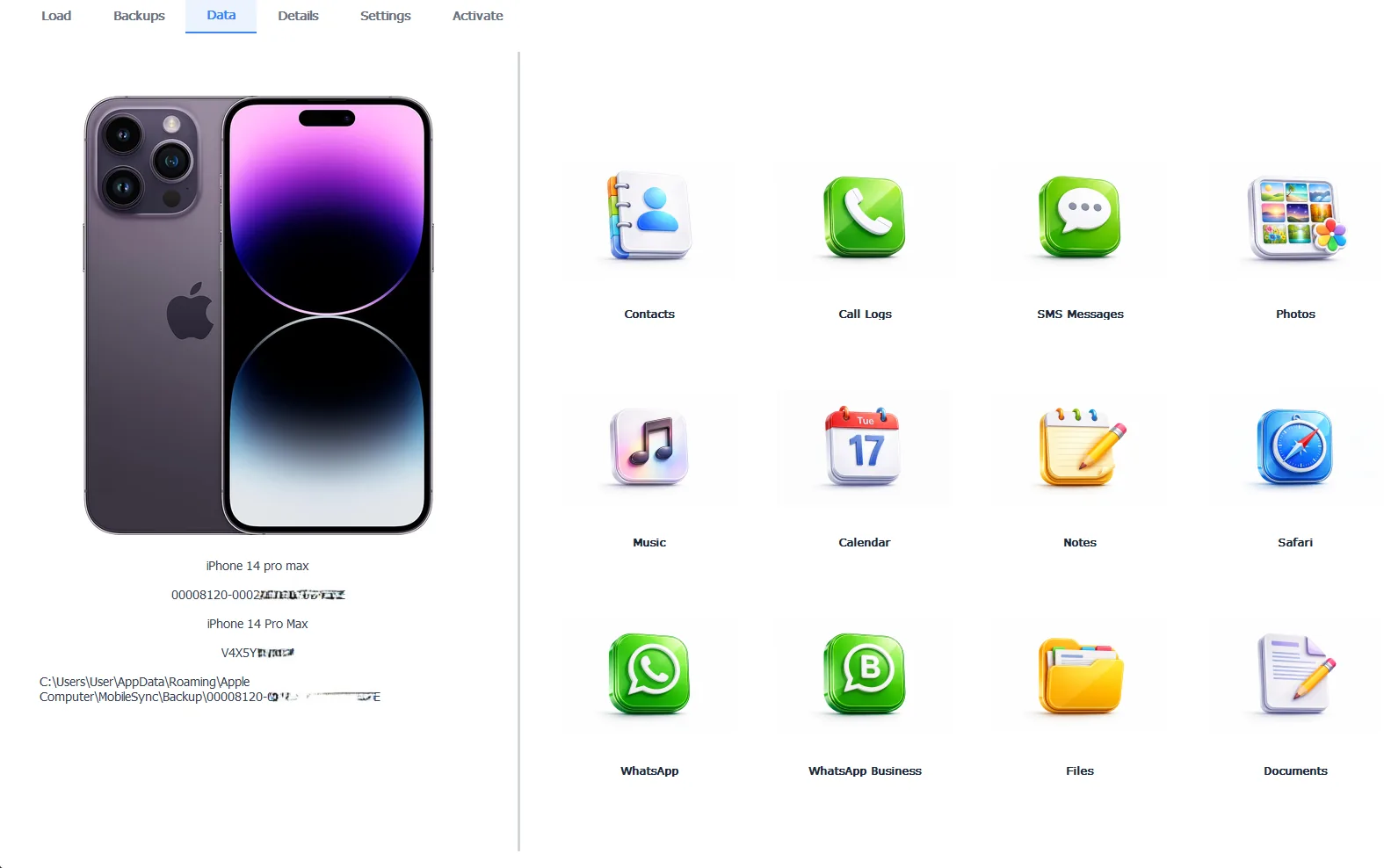
Step 5: iData Backup Viewer displaying data extracted from an iPhone backup by category
Everything runs 100% locally on your PC. Nothing uploads anywhere. The free version previews your full backup, and the Pro edition at $49 per year unlocks full exports.
Free version previews your backup contents. Works on Windows 10 and 11.
Can You Move iPhone Backups to Another Drive?
Yes, but Apple gives you no setting for it. iTunes and the Apple Devices app always write to the default path on C:. The workaround is a folder junction, which quietly redirects Windows to a different drive.
- Close iTunes. Copy the whole Backup folder to the new drive, for example D:\iPhoneBackup.
- Rename the original Backup folder to Backup-old.
- Open Command Prompt as administrator and run mklink /J “C:\Users\YourName\AppData\Roaming\Apple Computer\MobileSync\Backup” “D:\iPhoneBackup”
- Run a test backup and confirm the new files land on D:.
One honest warning before you try this. Apple doesn’t support junctions, and a Windows reinstall or a major iTunes update can break the link. For this reason, keep the Backup-old folder until you’ve confirmed at least one full backup and restore on the new setup.
What If the Backup Folder Is Empty or Missing?
An empty Backup folder has three common causes, and the fix is different for each.
Your iPhone backs up to iCloud, not your PC. iCloud backups live on Apple servers and never touch your hard drive. On your phone, open Settings, tap your name, then iCloud, then iCloud Backup. If it’s on and you’ve never plugged into iTunes, there’s simply no local backup to find.
You’re checking the wrong one of the two paths. A backup made by Microsoft Store iTunes won’t appear in the AppData folder, and the reverse is also true. Check both locations from the table before assuming the backup is gone.
The backup was made under a different Windows account. Each user account has its own AppData and profile folders. So a backup created while your family member was logged in sits under their username, not yours.
So the mystery folder isn’t really a mystery. Desktop iTunes writes to AppData\Roaming\Apple Computer\MobileSync\Backup, and the Store version plus the Apple Devices app write to Apple\MobileSync\Backup under your user profile. Finding the folder is step one. Reading it is the part Apple never built for Windows, and that’s exactly what a backup viewer fixes.
Found your backup folder but not sure what’s actually saved inside it?
Frequently Asked Questions
Can I open an iPhone backup without iTunes installed?
Yes. The backup is a normal folder on your PC, so a backup viewer reads it directly. iData Backup Viewer opens iTunes backups on Windows 10 and 11 without needing iTunes on the machine.
Are iCloud backups stored on my PC as well?
No. iCloud backups live on Apple servers and never touch your hard drive. Only backups made with desktop iTunes, Microsoft Store iTunes or the Apple Devices app sit in the MobileSync folder on your PC.
Deleting old backups safely
Delete backups from inside iTunes or the Apple Devices app using Manage Backups. If you delete manually, remove the entire device folder with the long 40 character name. Never delete individual files inside it.
The Backup folder is taking a lot of disk space
Each device gets one full backup, and a single modern iPhone backup regularly crosses 20GB. Archived copies multiply that fast. Check the size of each device folder and remove backups for devices you no longer own.
Can I read an encrypted iTunes backup?
Yes, as long as you know the backup password. Enter it once in iData Backup Viewer and the app decrypts the backup locally, then shows messages, photos, WhatsApp chats and more.
Where are iPhone backups stored on Mac?
macOS keeps them at ~/Library/Application Support/MobileSync/Backup. Open Finder, press Cmd+Shift+G and paste that path to jump straight there.
Written by Viralkumar Patel in
Viralkumar works on iData Backup Viewer at CYBERSICS SOLUTIONS, where he helps Windows users read, recover and export data from iPhone backups.