Why Is My iPhone Backup So Large? (And What to Do)



Sixty gigabytes for a backup feels wrong until you see what’s in it. So why is my iphone backup so large? Because it holds far more than the photos you remember taking. Every picture ever texted to you lives in there. So do years of app data, attachments you forgot existed and the full weight of a phone you’ve owned for ages. The size isn’t a bug. It’s an honest headcount of your digital life. Once you can see the headcount, shrinking it safely gets easy.
Summary
iPhone backups are large mostly because of photos, videos and years of message attachments. Turning on iCloud Photos removes the library from the local backup and shrinks it the most. Retiring old device backups and moving the folder to a bigger drive handle the rest without risking your data.
| The Space Hog | Why It’s Big |
|---|---|
| Photos and videos | The single biggest category by far |
| Message attachments | Years of texted photos and videos |
| App data and caches | Games and social apps hoard files |
| Old device backups | Past phones still taking up room |
Table of Contents
Why Is My iPhone Backup So Large?
Because a backup is the whole phone, not the highlights. Four categories do most of the damage. Photos and videos lead every time, the camera roll being the heaviest thing most people own. Message attachments come second and shock everyone. Every photo and video ever texted to you sits saved in the backup, a hidden library detailed in our guide to extracting photo attachments from messages. App data fills the middle, games and social apps caching gigabytes quietly. And old device backups linger, past phones you replaced still parked in the same folder.
The full inventory of everything a backup captures, category by category, lives in our pillar on what is inside an iPhone backup. Read it and the size stops feeling mysterious. A backup is large for the same reason a house is heavy. You filled it over years.
How Do You See What’s Actually Taking the Space?
Guessing wastes effort, so look instead. iData Backup Viewer opens the backup on Windows 10 or 11 and shows every category it holds, the photos, videos, message attachments, contacts and more, free to browse. Watching the sheer volume of texted photos scroll past is the moment the size finally makes sense for most people.
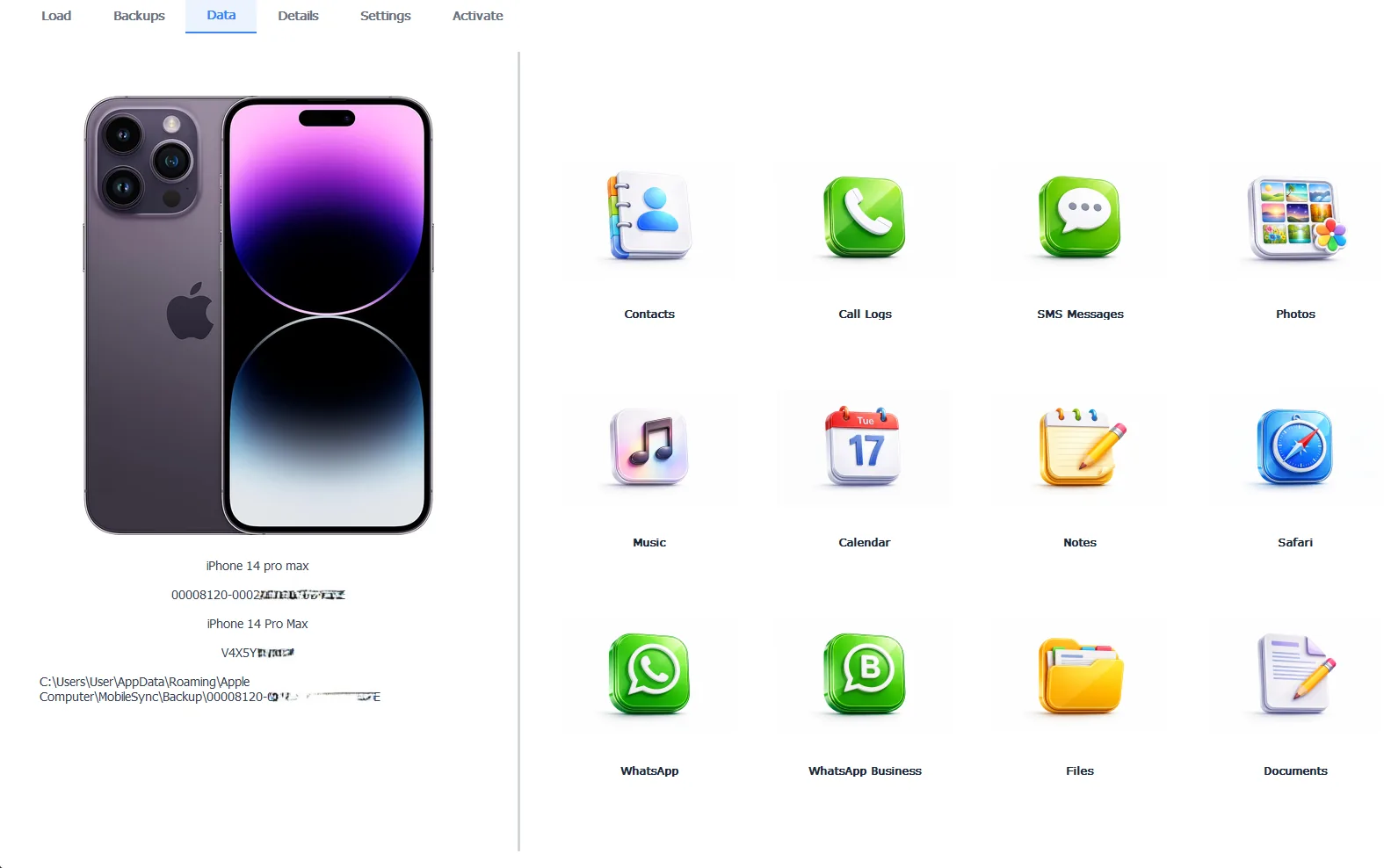
The backup’s real contents, where the gigabytes actually went
Seeing inside also unlocks a smarter move than shrinking. Export the irreplaceable photos and conversations to your PC as files first, using the Pro edition at $49 per year, 100% locally. Once the precious parts live safely as files, trimming backups feels a lot less frightening. Browsing to find them costs nothing.
Free version previews your backup contents. Works on Windows 10 and 11.
How Do You Shrink It Without Losing Anything?
Turn on iCloud Photos. The biggest lever by far. With iCloud Photos on, the camera roll lives in iCloud and drops out of the local backup, cutting the size sharply. The tradeoff is honest, your photos then depend on iCloud rather than the backup, so keep exported copies of the irreplaceable ones on your PC either way.
Retire old device backups. Past phones sitting in the folder are pure reclaimable space. Preview each to be sure it holds nothing you still want, then remove it through the safe method in our guide to deleting iPhone backups on Windows, which previews before anything goes.
Move the folder to a bigger drive. When the issue is a cramped C: drive rather than the backup itself, relocate the whole backup to an external drive with the junction method in our guide to backing up an iPhone to an external drive. The backup keeps its full size and stops crowding Windows.
Skip the reckless shortcuts. Deleting files inside a live backup to save space corrupts the whole thing. There’s no safe hand-editing of a backup folder. Shrink through the levers above or not at all.
“People panic at a huge backup and want to hack it smaller, which is exactly how backups get corrupted. The size is the backup doing its job, holding everything. Open it, see that the bulk is photos, save the ones that matter as files and then shrink through the front door. A big backup is a full backup. Full is what you wanted.”
Viralkumar Patel in | iData Backup Viewer Team, CYBERSICS SOLUTIONS
Why Is the Backup Bigger Than My Phone Says?
The used-storage number in Settings and the backup size measure different things, so the gap is normal. Settings shows tidy current usage. A backup also carries items marked deleted but not yet purged, the full contents of app data folders and message attachments that never counted as photos in your library. Add those and the backup reasonably outweighs the headline number.
An encrypted backup can also run a touch larger, since it captures extra categories like saved passwords and health data that plain backups skip. That’s more value stored, not wasted space. Encryption stays worth it. The encryption picture in full sits in our guide to backing up an iPhone to a computer.
When Is a Large Backup Perfectly Fine?
Most of the time, honestly. A big backup only needs action when it crowds your disk or drags the backup speed. Even then the fix is the levers above, never gutting the backup. If the complaint is really slowness rather than size, that’s a different diagnosis handled in our guide to iPhone backups taking forever.
A large, complete, readable backup is a good thing to own. It means your whole phone is recoverable, which is the entire point. Verify it opens and holds your life, keep the disk space healthy and let it be as big as your life is. Every other backup question finds its answer in our iPhone data recovery hub.
So the size was never the enemy. Photos and attachments fill most of it, iCloud Photos shrinks it the most, old backups and a roomier drive handle the rest and the backup stays whole through all of it. See inside first, save what’s precious and shrink through the front door.
Have you looked inside to see where your gigabytes actually went?
Frequently Asked Questions
What takes up the most space in an iPhone backup?
Photos and videos almost every time, followed by years of attachments buried in messages and chat apps. The visible photo library is only part of it, since every picture ever texted to you sits in the backup too.
Why is my backup bigger than the storage used on my phone?
It mostly isn’t, once you count what the phone hides. Deleted-but-not-purged items, app caches and message attachments all add up, so a backup can look larger than the tidy number Settings shows for used space.
Does turning on iCloud Photos shrink the computer backup?
Yes, sharply. With iCloud Photos on, the library lives in iCloud and drops out of the local backup, which can cut the backup size dramatically. The tradeoff is that the photos then need iCloud to be reachable, not the backup.
Is a large backup a problem or just big?
Big is fine if you have the disk space. It becomes a problem only when it crowds your C: drive or makes backups crawl, both of which have clean fixes below rather than any need to gut the backup.
Will deleting old backups free space safely?
Yes, when you keep at least one good backup and preview it first. Old device backups you no longer need are pure reclaimable space, removed through the safe method in our delete guide.
Can I stop the backup from including certain apps?
Not selectively on Windows in the way iCloud allows. The lever you do have is iCloud Photos for the biggest category, plus retiring old backups and moving the whole folder to a roomier drive.
Written by Viralkumar Patel in
Viralkumar works on iData Backup Viewer at CYBERSICS SOLUTIONS, where he helps Windows users read, recover and export data from iPhone backups.